


- What Don't We Know?
- Lean IT Is Not About Cost Cutting. It Is About Respecting Time.
- Business–IT Convergence Is Not a Strategy. It Is a Discipline.
- Responsible AI in The Enterprise.
- Relevance Is a Moving Target: Why Most Leaders Are Already Behind on AI.
- AI Is Reallocating Value—Not Jobs: Who Wins, Who Struggles, and Why.
- AI Didn’t Evolve Linearly. It Advanced in Bursts—and That Pattern Will Decide Who Wins by 2040.
- AI Isn’t the Next Industrial Revolution — It’s a Break in the Pattern.
- Proving the ROI of AI: Why CIOs Must Move Beyond Experiments and Start Leading.
- Critical Infrastructure Protection: IT as the Backbone of National Resilience.
What Don't We Know?

Sanjay K Mohindroo
Rethinking What AI Should Actually Do for Litigation
A litigator I once spoke with described the worst moment in any case this way: it isn't the day you lose an argument in court. It's the day, often late in preparation, when you realize there's a question about your own case that nobody ever answered, and you have no way of knowing whether opposing counsel already has.
It's rarely because anyone hid anything. It's because a real case file isn't a handful of documents you can hold in your head. It's thousands of pages: pleadings, emails, messages, financial records, scanned exhibits, witness statements. Somewhere in that volume, a question sits unasked.
Not what does this document say?
But what haven't we looked for yet?
That distinction is the starting point for a system I've been designing, and it's why I think there is still an important problem for legal AI to solve.
The limits of the "answer machine"
Today's legal AI tools can do remarkable things. They can search enormous document sets, summarize depositions, identify clauses, build timelines, help draft submissions, and surface information that would otherwise take hours to find.
But many of those workflows still begin in the same place: with a question the lawyer already knows to ask.
"Summarize this deposition."
"Find every clause referencing termination."
"Show me communications between these two people."
"Draft a response to this motion."
The system may answer extremely well. But the interaction remains largely reactive.
In litigation, that is a narrower kind of help than it first appears.
Cases are not always weakened by a document nobody read. Sometimes they are weakened by a document nobody thought to go looking for, a contradiction nobody cross-checked, an assumption everyone treated as settled, or a gap in the evidentiary chain that only becomes obvious once opposing counsel points it out in front of a judge.
An AI system that waits entirely for the right question can still miss this category of risk.
Because nobody asked.
A different question: what don't we know?
The idea I've been designing around inverts the usual approach.
Instead of only answering what the evidence says, the system should also actively surface what the available evidence doesn't establish, and flag that gap as something requiring attention rather than treating silence as an answer.
Imagine that, for every material proposition in a case, the system maintains something like this:
Claim: The disputed communication was sent by the account holder.
Evidence currently available: Login record, email metadata, one witness statement.
Evidence potentially missing: Authentication logs, device history, IP records, provider access logs covering the relevant period.
Why the gap matters: The available material may establish that the account was used, but not necessarily that a particular person or device sent the communication. Attribution therefore remains contestable.
Recommended next step: Determine whether provider or device-access records exist for the relevant period and, if appropriate, seek them before they become unavailable.
This is a small example, but the pattern can generalize across an entire case.
Every witness statement. Every contested date. Every material allegation. Every proposition resting on only partial documentary support.
The output isn't simply another narrative summary of the case.
It's a structured map of where the case stands, where the evidence is strong, and where it does not yet stand at all.
But how does a system know something is missing?
This is the difficult part.
A system cannot call something "missing" unless it has some basis for believing that the evidence should exist, might ordinarily exist, or would be relevant to establishing the proposition in question.
That requires more than semantic search.
For each material proposition, the system would need to reason about the kinds of evidence that could support or undermine it: documentary records, communications, system logs, witness testimony, financial trails, timelines, approvals, provenance, authentication, or other evidence depending on the nature of the case.
In other words, the task is not merely:
What documents do we have?
It is also:
What would we ordinarily expect to examine before treating this proposition as established?
That distinction matters.
The system should not invent evidence that ought to exist. Nor should it present an absent record as proof of anything. It should identify an unresolved evidentiary question, explain why that question follows from the material already available, and let the lawyer determine whether the gap is real, relevant, obtainable, or immaterial.
This is less about magically discovering every "unknown unknown" in a case.
It's about systematically turning some unknown unknowns into known unknowns while there is still time to investigate them.
Why gaps matter more than answers
Opposing counsel's job, in an adversarial system, is in significant part to find these weaknesses precisely: the places where your case rests on an inference, an assumption, an incomplete chain of evidence, or a witness whose account doesn't quite align with the documents.
The earlier your own side identifies those weaknesses, the more options you have.
You may obtain the missing evidence.
You may discover that the evidence doesn't exist.
You may reconsider part of the theory of the case.
Or you may decide that the gap cannot be closed and prepare a considered response to it before somebody else raises it.
A system that only tells you what you already have can make preparation faster.
A system that also tells you what you may still need could make preparation different.
It changes the question from:
"Have we read everything?"
to:
"What would we still need to know before we were comfortable defending this proposition?"
Then attack your own case
There is a related capability that I think matters just as much, but it is slightly different.
Finding gaps is one task.
Actively exploiting them is another.
Once the system has mapped the claims, evidence, contradictions and unresolved questions in a case, it should be capable of switching sides.
If instructed to act as opposing counsel, how would it attack the case?
Which witness accounts conflict?
Which propositions rely disproportionately on one source?
Which dates don't reconcile?
Which documents support an inference without actually proving it?
Where is causation assumed?
Where is attribution uncertain?
What would a hostile cross-examination focus on?
What alternative interpretation of the same evidence could reasonably be advanced?
The purpose wouldn't be to predict exactly what opposing counsel will say. It would be to subject your own case to structured adversarial pressure before somebody else does.
These are therefore two related but distinct functions:
Gap detection: What haven't we established yet?
Adversarial testing: Given what we have established, how could someone attack it?
The goal of both is the same: surface risk while there is still time to do something about it.
What this isn't
This kind of system should not be presented as a replacement for legal judgment.
Quite the opposite.
Every gap it identifies, every contradiction it flags, and every vulnerability it suggests should be traceable to the material from which the conclusion arose.
A lawyer should be able to move from an AI-generated observation directly to the relevant document, page and passage and see exactly why the system raised it.
If the system says two accounts contradict each other, show both.
If it says a proposition is supported only indirectly, show the chain of evidence.
If it suggests that a particular category of evidence might be missing, explain why that evidence would matter.
And where the system is uncertain, it should say so plainly.
There is an important difference between:
"The evidence does not establish this."
and
"Based on the material currently available to the system, I cannot establish this."
Legal AI needs to understand that distinction.
Evidence-grounded and verifiable versus persuasive but unverifiable is, in my view, one of the lines separating an AI tool that genuinely reduces risk from one that quietly introduces new risk into a case.
Where this goes next
This is currently a design, not a finished product, and I think that's the honest way to describe it.
Before building further, I want to test the underlying problem against how litigators, in-house counsel and law firms actually work today.
How do legal teams currently identify gaps in large case files?
At what stage do they usually discover that something important is missing?
How much of this happens systematically, and how much depends on the instincts and experience of individual lawyers?
What tools already help?
Where do those tools fall short?
And, most importantly, would a system that continuously maps evidentiary gaps and stress-tests the case actually change how lawyers prepare, or would it simply become another dashboard nobody has time to look at?
If you litigate, manage a firm's caseload, work in-house, or have been on the other side of one of these late-discovered gaps as a litigant, I'd like to hear about it.
What's the moment in your own case preparation where you most wished you'd known what you didn't know?
Those conversations, rather than my own assumptions about the problem, should decide whether this is worth building and what it should actually do first.
Reach out at info@usscpartners.com. I'm setting up a handful of conversations with practicing lawyers over the next few weeks.
Lean IT Is Not About Cost Cutting. It Is About Respecting Time.
Sanjay K Mohindroo
A senior IT leader’s perspective on Lean IT, how to remove operational friction, and why efficiency comes from clarity, not cost cutting.
Lean IT is often misunderstood as a cost reduction exercise. That is where most organizations get it wrong.
Lean thinking in IT is about flow, clarity, and disciplined execution. It focuses on removing friction that slows delivery, frustrates teams, and weakens business outcomes.
In my experience across large global organizations, the most effective IT functions are not the biggest or the most funded. They are the ones that move with precision.
This piece explores how Lean thinking applies to IT operations in the real world, where it breaks down, and what leadership must do to make it sustainable. #Leadership #CIO #LeanIT
The hidden cost no one measures
Ask any CIO about cost pressures, and you will get a detailed answer. Infrastructure spend. Vendor contracts. Headcount.
Ask them how much time is wasted across IT operations, and the room goes quiet.
Time is the most under-managed asset in IT.
I have seen teams spend weeks waiting for approvals, chasing dependencies, reworking unclear requirements, and fixing avoidable defects. Not because people lack capability, but because systems lack flow.
Lean IT starts with a simple question.
Where is time being lost, and why?
What Lean Really Means in IT
It is about flow, not frameworks
Lean thinking did not originate in IT. It came from manufacturing, where efficiency is visible and measurable.
In IT, the waste is less visible. It hides in processes, handoffs, and decisions.
Lean IT focuses on flow. Work should move smoothly from idea to delivery without unnecessary delay or rework.
In one organization, we mapped the lifecycle of a simple change request. It took 28 days end to end. The actual work took less than 6 hours.
The rest was waiting.
Approvals, queue delays, unclear ownership.
Once we removed those friction points, delivery time dropped to under a week. No new tools. No additional budget. Just clarity and discipline.
That is Lean IT in practice. #LeanThinking #ITOperations
The Waste We Ignore
Not all inefficiencies look like problems
In IT, waste does not always appear as failure. It often looks like normal operations.
Multiple status meetings that do not change outcomes
Repeated data entry across systems
Over-engineered solutions for simple problems
Long approval chains that add no real value
These are accepted as part of the system. They should not be.
In one transformation, we eliminated over 30 percent of recurring meetings. Not because meetings are bad, but because many existed without purpose.
The result was immediate. More time for actual work. Better focus. Faster decisions.
Lean thinking forces organizations to question what they have normalized.
Efficiency does not come from doing more with less. It comes from doing less of what does not matter
There is a persistent belief that Lean IT is about pushing teams to do more with fewer resources.
That belief is flawed.
Pushing teams harder without addressing system inefficiencies leads to burnout, not performance.
True efficiency comes from removing unnecessary work.
I have seen organizations invest heavily in automation while ignoring process complexity. They automate inefficiency and call it progress.
In one case, a team automated a reporting process that no one actually used for decision-making. It saved hours of effort. It added no value.
Lean IT starts with value. What matters. What does not.
Only then does efficiency follow. #OperationalExcellence
Designing Lean into IT Operations
Build systems that reduce friction
Lean IT must be designed into how work flows, not added as a layer on top.
Start by mapping key workflows. Identify delays, bottlenecks, and rework points.
Simplify wherever possible.
Reduce handoffs. Each handoff introduces delay and risk of misalignment.
Clarify ownership. When everyone is responsible, no one is accountable.
Standardize where it adds value, but avoid rigidity.
In a global rollout I led, we reduced the number of approval layers from six to two for most operational decisions.
The impact was immediate. Faster execution. Better accountability.
Leaders often underestimate how much speed comes from simplicity.
The Role of Leadership
Lean fails without leadership discipline
Lean IT is not a process initiative. It is a leadership discipline.
Leaders set the tone for what is acceptable.
If delays are tolerated, they will multiply.
If complexity is ignored, it will grow.
If clarity is missing, teams will create their own versions.
In organizations where Lean worked, leaders were deeply involved. Not in micromanaging tasks, but in shaping systems.
They asked simple questions repeatedly.
Why does this step exist
Who benefits from it
What happens if we remove it
These questions sound basic. They are not easy to answer.
Because they challenge long-standing habits.
Lean and Technology
Tools do not create flow. Systems do
There is a tendency to look for technology solutions to operational problems.
Workflow tools. Automation platforms. AI-driven optimization.
These are useful. But they are not the starting point.
If the underlying process is unclear or inefficient, technology will amplify the problem.
In one organization, we paused a major automation initiative. Instead, we spent six weeks simplifying workflows.
When automation resumed, it delivered twice the impact with half the complexity.
Lean thinking ensures that technology supports flow, rather than masking inefficiencies.
What Gets in the Way
The quiet barriers to Lean IT
Lean IT sounds simple. It is not easy to sustain.
Common barriers include
Cultural resistance to change
Fear of losing control when processes are simplified
Misaligned incentives across teams
Short-term pressure that overrides long-term discipline
I have seen Lean initiatives start strong and fade within months.
The reason is predictable.
They are treated as projects, not as ways of working.
Lean requires consistency. Small improvements, repeated over time.
What senior leaders should act on
Measure time as a critical asset across IT operations
Identify and eliminate non-value-adding activities
Simplify workflows and reduce handoffs
Align accountability clearly across teams
Use technology to support, not replace, Lean thinking
Embed Lean principles into daily operations, not as a separate initiative
Create leadership focus on flow, not just output
Speed comes from clarity, not pressure
Lean IT is not about cutting costs or reducing headcount.
It is about creating systems where work flows smoothly, decisions are clear, and teams can focus on what matters.
The organizations that succeed are not the ones that push harder.
They are the ones that remove friction.
In a world where speed is critical, clarity becomes the real advantage.
And Lean thinking, applied with discipline, delivers exactly that.
#LeanIT #Leadership #CIO #OperationalExcellence #DigitalTransformation #ITOperations #ProcessImprovement #EnterpriseIT #TechnologyLeadership #BusinessEfficiency
Business–IT Convergence Is Not a Strategy. It Is a Discipline.
Sanjay K Mohindroo
A senior IT leader’s perspective on Business–IT convergence, why most efforts fail, and how leadership can make alignment work in real organizations.
Every organization claims alignment between business and IT. Very few achieve it.
Business–IT convergence is not about structure charts, reporting lines, or new roles. It is about how decisions are made, how priorities are set, and how accountability is shared.
In my experience across global enterprises, convergence works when technology is treated as a business capability rather than a support function. It fails when IT is invited late, measured narrowly, or expected to execute without context.
This piece breaks down what real convergence looks like, why most efforts stall, and what leaders must do differently to make it work at scale. #Leadership #CIO #DigitalTransformation
The meeting that says everything
I have seen this pattern too many times.
The business presents a bold growth plan: expansion, new markets, sharper customer experience. The room is energized.
Then someone turns to IT.
“How long will this take?”
At that moment, convergence has already failed.
Because IT was not part of shaping the plan. It was brought in to react to it.
Business–IT convergence is not about faster execution. It is about shared thinking before execution begins.
The Illusion of Alignment
Why most organizations believe they are aligned when they are not
Many organizations confuse communication with alignment.
Weekly meetings. Steering committees. Status updates. These create visibility, not alignment.
Alignment means something deeper. It means both sides understand the same priorities, trade-offs, and outcomes. It means decisions are made with a shared view of value.
In one organization, business leaders pushed for rapid feature releases. IT pushed back, citing system stability. Both were right. Neither was aligned.
We reframed the conversation. Not speed versus stability, but revenue impact versus operational risk.
That changed everything.
The debate shifted from functions to outcomes. That is where convergence begins. #BusinessStrategy #ITLeadership
Technology Is the Business
Stop treating IT as a delivery arm
There is still a quiet assumption in many boardrooms that IT exists to support the business.
That assumption no longer holds.
Technology shapes customer experience, pricing models, supply chains, and even revenue streams. In many industries, it is the business.
When I led large-scale transformations, the most effective shift was simple. We stopped asking, “What does the business need from IT?”
We started asking, “How do we design the business with technology at its core?”
That shift moved IT leaders from the sidelines to the center of strategic conversations.
It also raised the bar. Because once you are at the table, execution matters even more.
Business–IT convergence does not fail because of silos. It fails because of leadership comfort
It is easy to blame silos. They are visible. They are measurable. They are convenient.
But silos are a symptom. Not the cause.
The real issue is leadership comfort.
Business leaders are comfortable defining strategy without technical depth. IT leaders are comfortable focusing on delivery without challenging business assumptions.
Both stay in their lanes. And convergence never happens.
In one global organization, we broke this pattern deliberately. Business leaders were required to present technology implications as part of strategy proposals. IT leaders were expected to challenge commercial assumptions, not just execution plans.
It was uncomfortable at first.
Then it became powerful.
Because convergence is not about breaking silos. It is about expanding leadership thinking. #ExecutiveLeadership
Designing for Convergence
Building structures that force collaboration
Convergence does not happen by intent. It happens by design.
The most effective organizations I have worked with did three things well.
They aligned funding to outcomes, not functions. Budgets were tied to business capabilities, not departments. This forced shared ownership.
They created joint accountability. Success metrics were shared between business and IT leaders. No one could succeed alone.
They embedded cross-functional teams. Not as a temporary initiative, but as a standard operating model.
In one case, we moved from project-based funding to capability-based funding. It reduced internal friction overnight.
Because people stopped negotiating budgets and started solving problems together.
The Execution Gap
Where convergence efforts quietly break down
Even when strategy is aligned, execution often drifts.
Priorities change. Timelines stretch. Trade-offs become unclear.
This is where many convergence efforts lose momentum.
The issue is not intent. It is discipline.
Clear decision frameworks are essential. Who decides. Based on what inputs. Within what timeframe.
Without this, alignment at the top does not translate into action on the ground.
I have seen transformations stall because teams waited for perfect clarity. In reality, progress requires structured ambiguity. Enough clarity to move, enough flexibility to adapt.
That balance is where leadership matters most.
The Role of the CIO
From technology leader to business partner
The CIO role has evolved. The expectations have changed.
It is no longer enough to deliver reliable systems and control costs.
Today, the CIO must shape business strategy, influence outcomes, and drive value creation.
This requires a different mindset.
Speak the language of business, not technology.
Frame conversations around impact, not implementation.
Challenge assumptions when needed.
In my experience, the most respected CIOs are not the most technical. They are the ones who bring clarity to complex decisions.
That is what boards value. #CIO
What Leaders Get Wrong
Common mistakes that slow convergence
There are patterns I see repeatedly across organizations.
Treating convergence as a one-time initiative rather than an ongoing discipline
Measuring IT on efficiency while expecting innovation
Involving IT too late in strategic discussions
Overloading teams with parallel priorities
Avoiding difficult trade-off conversations
Each of these seems manageable in isolation. Together, they create friction that slows everything down.
Convergence requires consistency. Not bursts of activity.
What senior leadership must act on
Bring IT into strategy discussions from day one
Align funding and metrics to business outcomes
Establish shared accountability across functions
Create clear decision frameworks
Simplify priorities and focus execution
Encourage leaders to operate beyond their functional comfort zones
Measure success through business impact, not activity
Convergence is a leadership choice
Business–IT convergence is not about tools, frameworks, or organization charts.
It is about how leaders think, collaborate, and decide.
The organizations that get this right move faster. They adapt better. They compete stronger.
Not because they have better technology.
But because they use it with clarity and purpose.
In the end, convergence is not achieved through initiatives. It is built through everyday decisions.
And that is where real leadership shows.
#BusinessITConvergence #Leadership #CIO #DigitalTransformation #ITStrategy #BusinessStrategy #ExecutiveLeadership #TechnologyLeadership #EnterpriseIT #OrganisationalDesign
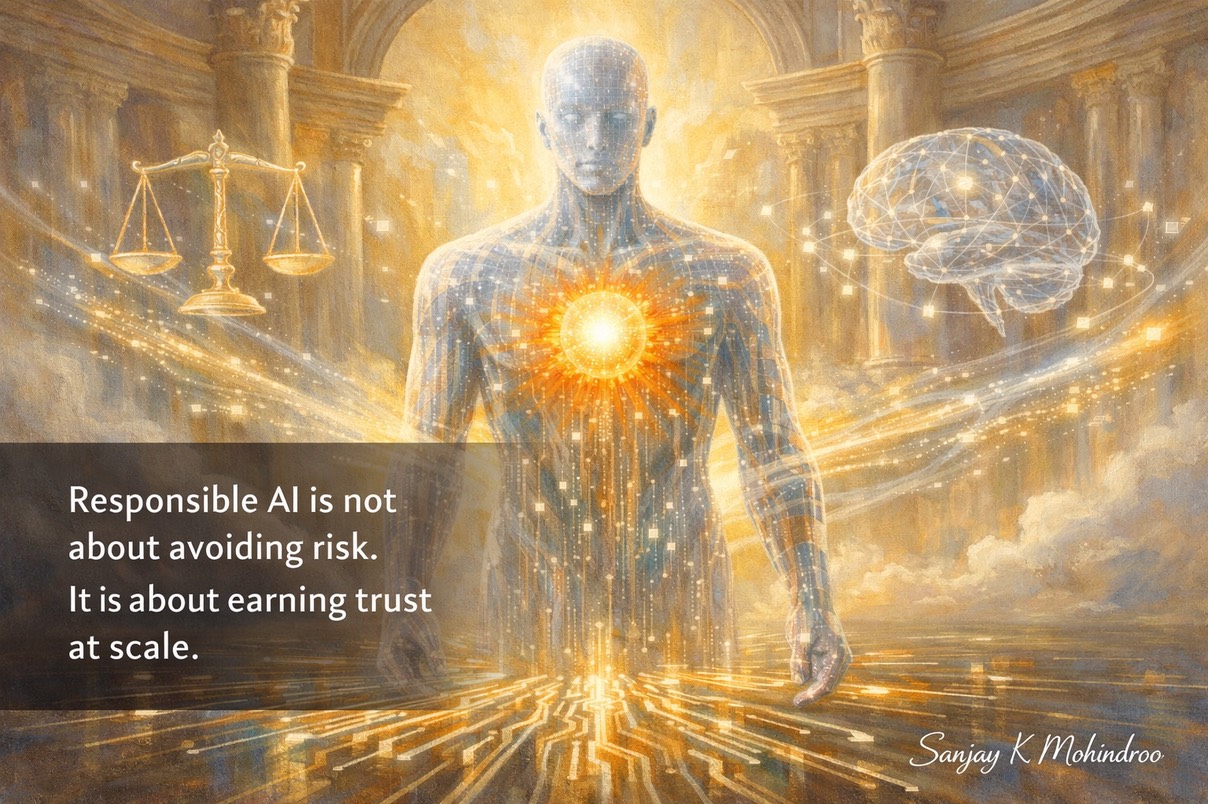
Responsible AI in The Enterprise.
Sanjay K Mohindroo
Responsible AI is no longer compliance. It is trust. A leadership roadmap for enterprise AI governance.
Beyond Compliance to Trust
Every board I speak to is asking the same question.
“How do we move fast with AI without breaking something we cannot repair?”
Responsible AI is no longer a legal checklist. It is a leadership test.
As technology executives, we are under pressure to deploy AI at scale. Productivity gains are real. Competitive advantage is real. The fear of falling behind is real.
But so is the risk.
Reputational damage. Regulatory penalties. Biased decision systems. Customer backlash. Employee distrust.
The real conversation is not about compliance. It is about trust.
Responsible AI in the enterprise is not a policy document. It is a design choice. A governance discipline. A cultural shift. And in many ways, it defines the credibility of digital transformation leadership in this decade.
The question is simple.
Are we building AI systems that people trust?
Or are we building systems that we merely hope will not fail?
This is not a technical debate.
It is a boardroom issue because AI now influences pricing, hiring, lending, supply chains, marketing, cybersecurity, customer engagement, and even strategic planning.
When AI makes decisions, it shapes outcomes that affect revenue, compliance exposure, and brand equity.
Trust has a financial value.
Customers withdraw trust quickly. Investors price risk aggressively. Regulators move faster than many anticipate. Employees resist tools they do not understand.
Responsible AI intersects directly with:
· Business performance
· Enterprise risk management
· Brand positioning
· Long-term competitive advantage
In digital transformation leadership, credibility is currency. AI failures erode that currency overnight.
Emerging technology strategy without responsible guardrails is fragile. It scales risk faster than value.
CIO priorities today are no longer limited to uptime, cost optimization, or cloud migration. They include algorithm transparency, ethical governance, explainability, and responsible data usage.
If AI is shaping decisions, leadership must shape AI.
Key Trends Shaping Responsible AI
Three shifts are changing the conversation.
First, AI is moving from experimentation to embedded infrastructure.
It is no longer a pilot project in a sandbox. It is embedded in ERP systems, CRM workflows, fraud detection engines, and board dashboards. This raises the stakes.
Second, regulators are accelerating.
From the EU AI Act to global data protection regimes, governance expectations are tightening. But compliance alone is reactive. It does not create trust. It only avoids penalties.
Third, employees and customers are more aware than ever.
People ask:
How was this decision made?
Was my data used ethically?
Can I challenge an AI decision?
Transparency is no longer optional.
From my experience advising enterprises undergoing IT operating model evolution, I see a pattern. Companies that treat responsible AI as a side project struggle. Those that embed it into architecture, governance, and culture move faster with less friction.
Responsible AI is not a brake. It is a steering system.
Leadership Insights and Lessons Learned
Insight One: Governance Must Be Designed, Not Declared
Many organizations publish AI principles. Very few operationalize them.
A slide that says “fair, transparent, accountable” changes nothing.
What works is structural integration:
Risk review checkpoints before model deployment
Clear ownership across legal, IT, and business
Documented model validation processes
Escalation paths for ethical concerns
What fails is symbolic governance.
If your product teams cannot explain how ethical review works in practice, you do not have responsible AI. You have marketing.
Insight Two: Explainability Is a Business Asset
Leaders often treat explainability as a technical burden.
In reality, it is a trust accelerator.
When business teams understand how a model works, they adopt it faster. When customers receive clear reasoning, complaints drop. When regulators ask questions, answers come quickly.
Data-driven decision-making in IT must be auditable. If leaders cannot explain how a system reached a decision, they lose strategic control.
Black boxes are not leadership tools.
Insight Three: Culture Determines Outcomes
Responsible AI cannot sit only with compliance teams.
It must become part of engineering culture.
Developers should ask:
Is this dataset representative?
Have we stress tested edge cases?
Are there unintended bias patterns?
If teams feel pressure to ship at any cost, risk multiplies. If leaders reward ethical caution alongside speed, the system matures.
The tone is set at the top.
Framework: The TRUST Model for Responsible AI
Here is a practical framework I use with executive teams. It is simple, usable, and scalable.
T – Transparency
Can stakeholders understand what the system does?
Is the documentation clear?
Are decision logs accessible?
R – Risk Mapping
Have we
identified operational, reputational, regulatory, and ethical risks?
Is there a structured risk scoring process before deployment?
U – Use Case Justification
Should AI be used here at all?
Is automation necessary?
Is human oversight required?
S – Safeguards and Monitoring
Do we have continuous model monitoring?
Are there drift detection systems?
Can we intervene quickly if anomalies appear?
T – Trust Feedback Loop
Is there a channel for users to question decisions?
Do we measure trust metrics?
Are we learning from complaints?
This model shifts the mindset from compliance to confidence.
Responsible AI is not about avoiding headlines. It is about building durable systems.
Case Study: Financial Services
A regional bank deployed an AI lending model to improve credit approvals.
Performance improved. Approval times dropped.
Then complaints surfaced.
Applicants from certain geographies were being rejected at higher rates. The model was trained on historical lending data that carried legacy bias.
The bank paused deployment. They created a cross-functional AI review board. They retrained the model with balanced datasets. They implemented explainable scoring outputs for applicants.
Short-term delay. Long-term trust gain.
Had they focused only on speed, the reputational damage would have been severe.
Case Study: Manufacturing Enterprise
A global manufacturer embedded AI into supply chain forecasting.
Instead of limiting governance to IT, they involved operations leaders, procurement heads, and compliance officers in design reviews.
They mapped supply disruption risks and ethical sourcing implications into the algorithm parameters.
Result: higher forecast accuracy and stronger supplier confidence.
Responsible AI improved resilience, not just compliance.
What Comes Next
The next wave of AI is autonomous agents.
Systems that not only recommend decisions but execute them.
This changes accountability.
Who is
responsible when an autonomous procurement agent signs a contract?
When does an AI-powered HR system filter candidates?
When does predictive maintenance shut down production lines?
Emerging technology strategy must prepare for autonomous decision layers.
Boards will soon demand AI governance dashboards alongside financial dashboards.
Trust will become measurable.
IT operating model evolution will include AI ethics officers, model risk councils, and integrated audit trails.
Digital transformation leadership will be judged not by how much AI was deployed, but by how responsibly it was integrated.
Call to Action
As senior leaders, we must move the conversation beyond compliance checklists.
Ask your teams:
Where could AI fail ethically?
How transparent are our models?
Who signs off on AI risk?
Do we measure trust?
Responsible AI is not a defensive posture.
It is a strategic positioning.
Organizations that earn trust will scale faster, attract better partners, retain customers longer, and navigate regulation with confidence.
The enterprises that ignore trust will spend the next decade repairing it.
What is your organization doing to move from compliance to trust?
Let’s discuss.
#DigitalTransformationLeadership #ResponsibleAI #CIOpriorities #EmergingTechnologyStrategy #ITOperatingModelEvolution #AIgovernance #EnterpriseAI #DataDrivenDecisionMaking #TechLeadership #BoardroomStrategy
Relevance Is a Moving Target: Why Most Leaders Are Already Behind on AI.
Sanjay K Mohindroo
A sharp, executive-level perspective on staying relevant in the AI era. Practical insights for CIOs, CEOs, and business leaders navigating workforce and strategy shifts.
AI is not just changing how work gets done—it is redefining what makes a role valuable. The shift is subtle but decisive. Execution is losing value. Judgment, system thinking, and adaptability are gaining it.
Leaders who treat AI as a tool will fall behind. Those who treat it as a structural shift in value creation will move ahead.
The path forward is clear: evolve from doing work to shaping how work happens.
The Quiet Shift Most Leaders Are Missing
In boardrooms, I still hear a familiar question:
“How will AI impact our business?”
It sounds reasonable. It’s also the wrong question.
Because AI is not waiting to “impact” anything. It is already reshaping how value flows inside organizations.
The real issue is not adoption. It’s relevance.
I’ve seen this pattern before—during large ERP rollouts, during cloud transitions, during global outsourcing waves. But this time feels different.
Those shifts changed how work was done.
This one is changing who remains valuable while work is being done.
And that’s where most leadership conversations are still lagging.
The Relevance Curve Is Rewriting Roles
From Execution to Strategic Leverage
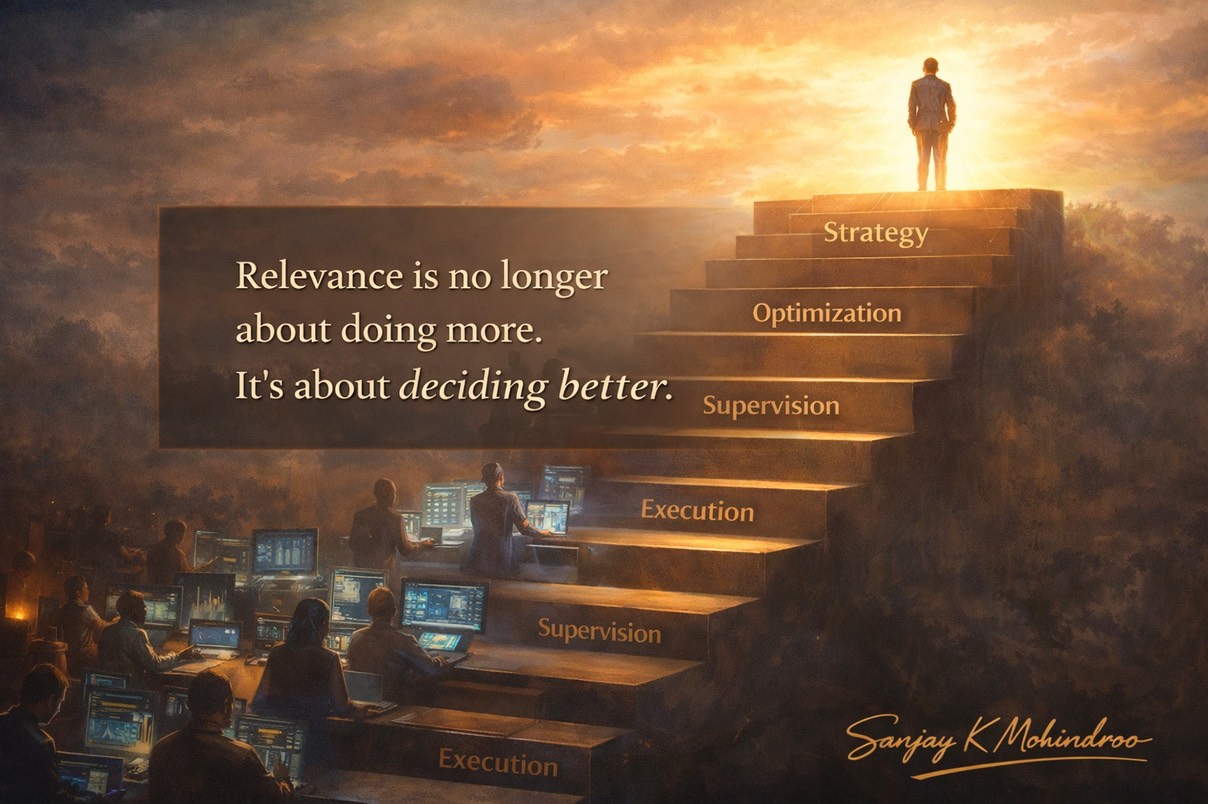
Every role today is moving along a simple but powerful progression:
Execution → Supervision → Optimization → Strategy
This is not a theory. It is visible across industries.
Execution is the process of performing tasks manually. It is predictable. Repeatable. And now, increasingly automated.
Supervision is the process of humans overseeing systems and AI outputs. It requires awareness, but not deep control.
Optimization is where real leverage begins. This is where people improve systems, refine outputs, and increase efficiency.
Strategy sits at the top. This is where direction is defined. Trade-offs are made. Value is created.
The problem is straightforward.
Most organizations are still structured—and rewarded—around execution.
And that is precisely where AI is accelerating fastest.
The Illusion of Productivity
Why Working Faster Is No Longer Enough
There is a common belief that using AI to work faster increases value.
It doesn’t. Not in a meaningful way.
Speed without direction only amplifies inefficiency.
I’ve seen teams generate more reports, more dashboards, more analysis than ever before—yet decision quality remains unchanged.
Why?
Because productivity is not the constraint anymore. Clarity is.
AI removes friction from execution. But it does not decide what matters.
That responsibility remains human.
And that is where the real shift in relevance is happening.
AI Is Not a Technology Problem
It’s a Leadership and Value Allocation Problem
Let’s challenge a popular narrative.
“Organizations need better AI strategies.”
In my experience, most don’t have a strategy problem. They have a value perception problem.
They are still assigning importance based on effort, not impact.
They reward:
- Hours spent
- Tasks completed
- Activity levels
While AI is quietly shifting value toward:
- Decision quality
- System thinking
- Outcome ownership
This mismatch creates friction.
Leaders invest in AI tools but expect traditional behaviors to deliver results.
That will not work.
AI does not transform organizations.
Leadership clarity does.
What Staying Relevant Actually Looks Like
A Practical Shift in How You Operate
Relevance today is not about mastering AI tools. It is about repositioning how you contribute.
At early career levels, the shift is from doing tasks to understanding why those tasks exist.
The moment someone starts questioning the purpose behind work, they begin moving up the value chain.
At mid-level roles, the shift is from managing people to designing systems.
The best managers I’ve worked with are not the ones chasing updates. They are the ones who remove the need for updates.
They build clarity into the system.
At senior levels, the shift is more demanding.
AI is no longer a support function. It is a business lever.
Revenue models are changing. Cost structures are compressing. Risk surfaces are expanding.
Leaders who see AI only as efficiency are missing its real potential—and its real threat.
The Three Non-Negotiables
Where Leaders Must Double Down
Across all roles, three capabilities are becoming essential.
AI Fluency
Not technical depth, but a working understanding. Enough to ask the right questions and challenge assumptions.
Domain Depth
AI can generate answers. It cannot replace context built over years of experience.
Learning Speed
This is the multiplier. The faster you adapt, the longer you stay relevant.
Miss one, and your growth slows.
Miss all three, and your relevance erodes quietly.
The 90-Day Reality Reset
What Leaders Should Do Now, Not Later
Transformation does not require a multi-year roadmap to begin. It requires a shift in behavior.
In the first month, exposure matters. Use AI in daily work. Not as an experiment, but as a habit.
In the second month, application matters. Integrate it into real workflows. Replace parts of your process.
In the third month, integration matters. Redesign how work gets done. Remove steps. Simplify decisions.
This is where most leaders stop short.
They experiment. They pilot. They discuss.
Very few redesigns.
And that is where the real advantage lies.
Strategic Takeaways for Leadership
- AI is compressing execution. Value is moving upward
- Productivity gains without decision clarity create noise
- Middle layers will shrink unless they evolve into system roles
- Leadership must redefine how value is measured and rewarded
- Speed of adaptation will outperform depth of experience alone
This is not a future scenario. It is already unfolding.
The Shift Is Quiet, But It Is Decisive
AI will not replace leadership.
But it will expose weak leadership.
Because when execution becomes easy, what remains is judgment.
Clarity. Direction. Accountability.
That is where relevance now lives.
And that is where leaders must operate.
#AI #Leadership #CIO #DigitalTransformation #FutureOfWork #EnterpriseStrategy #Innovation #BusinessTransformation #TechnologyLeadership #ExecutiveLeadership
AI Is Reallocating Value—Not Jobs: Who Wins, Who Struggles, and Why.
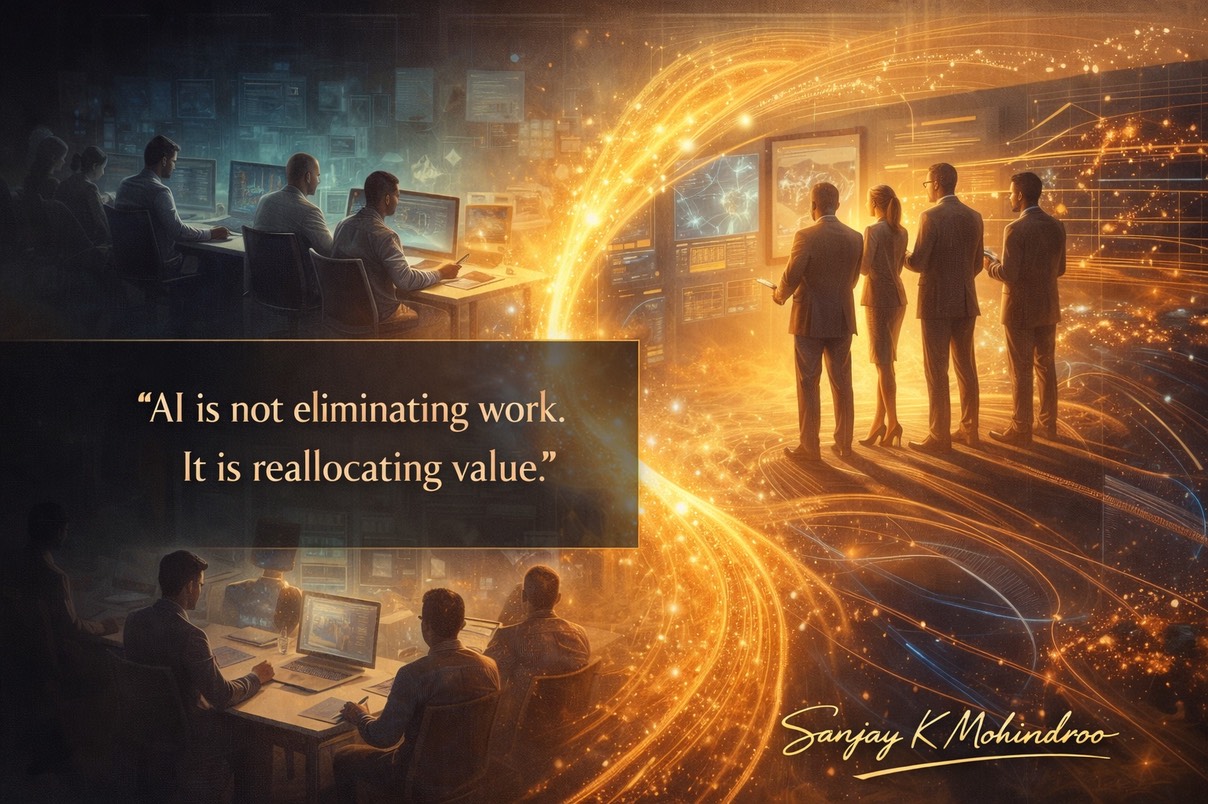
Sanjay Mohindroo
AI is not eliminating jobs—it is shifting value across roles. A strategic perspective on who wins, who struggles, and what leaders must do now.
AI is not eliminating work. It is shifting
where value sits inside organizations.
Execution is becoming cheaper. Judgment, context, and systems thinking are becoming
scarce.
The winners will not be those who work harder. They will be those who move closer to decision-making and value creation.
This shift is already underway. Most organizations just haven’t labeled it yet.
The Quiet Shift Leaders Are Missing
In boardrooms, the conversation still circles a
familiar concern:
“Which jobs will AI replace?”
It’s the wrong question.
After three decades of leading technology transformations across industries, I’ve learned that disruption rarely announces itself clearly. It shows up as small shifts in relevance. A role loses a bit of influence. A team becomes slightly less central. Decisions move elsewhere.
And then one day, the structure looks completely different.
That’s what AI is doing right now.
Not with noise. With precision.
The real shift is not job loss.
It is value migration.
And if you don’t track where value is moving, you will miss where your organization is weakening. #Leadership #AI #CIO
Blue Collar Work Is Not Disappearing. It Is Being Elevated
From effort to oversight
On the ground, the change is visible but often misunderstood.
Machines are taking over repetitive execution. That part is clear. What is less discussed is what replaces it.
The role is not vanishing. It is being reshaped.
Work is moving from:
- Doing tasks
- To manage machines that perform those tasks
This sounds incremental. It is not.
The skill set shifts from physical execution to:
- Interpreting machine output
- Diagnosing issues
- Adjusting processes in real time
The gap between those who adapt and those who don’t will widen quickly.
I’ve seen this pattern before in manufacturing transformations. The highest performers were not the fastest operators. They were the ones who understood the system behind the machine.
That principle now applies across sectors.
White Collar Work Is Facing Its First Real Compression
Execution is no longer a differentiator
For years, white-collar roles were protected by complexity.
Writing reports, analyzing data, and creating presentations—these were considered skilled tasks.
AI has changed that equation almost overnight.
Execution is becoming:
- Faster
- Cheaper
- Widely accessible
Which means it is losing value.
The real shift is subtle but powerful:
From:
- Completing tasks
To:
- Defining the right problems
That distinction separates relevance from redundancy.
AI can generate answers at scale.
It cannot determine which questions matter in a business context.
That requires:
- Judgment
- Context
- Experience applied with clarity
This is where leaders must recalibrate expectations.
High output is no longer impressive.
High-quality thinking is.
#FutureOfWork #DigitalTransformation
Middle Management Is at an Inflection Point
Coordination is being automated out of existence
If there is one layer where the impact will be most visible, it is middle management.
For decades, organizations relied on managers to:
- Track progress
- Coordinate teams
- Escalate issues
- Consolidate reporting
AI is quietly absorbing much of this.
Dashboards replace status meetings.
Automation replaces follow-ups.
Real-time data replaces summaries.
This creates an uncomfortable reality.
Managers who rely on coordination as their core value will find themselves squeezed.
The role is not disappearing. It is evolving.
The new expectation is clear:
- Design systems
- Enable flow of work
- Remove friction at scale
In simple terms, managers must shift from controlling work to architecting work.
That is a very different capability.
Leadership Is Entering a Continuous Strategy Cycle
Planning is no longer periodic
At the executive level, the shift is more strategic—and more demanding.
AI is accelerating:
- Market signals
- Competitive moves
- Customer expectations
The traditional planning cycle is under pressure.
Annual strategy reviews are starting to look outdated in fast-moving environments.
The new reality is continuous adaptation.
Leaders must now:
- Reassess assumptions more frequently
- Make decisions with incomplete data
- Act faster without losing direction
This is not about reacting. It is about staying aligned while the ground moves.
In my experience, the leaders who succeed here are not the most technical. They are the ones who maintain clarity under pressure.
AI amplifies complexity. Leadership must simplify it.
#CIO #BusinessStrategy #AILeadership
AI Is Not Eliminating Jobs. It Is Exposing Mediocrity
The real disruption is not where most people are looking
There is a widely accepted narrative:
AI will replace jobs, and new jobs will emerge.
That framing is incomplete.
What AI is actually doing is exposing the difference between:
- Value creators
- Task performers
Average performance used to be sustainable. Organizations had enough inefficiency to absorb it.
That buffer is shrinking.
AI does not tolerate mediocrity well. It replaces it quietly.
This is uncomfortable but necessary to acknowledge.
Experience alone is losing weight.
Effort alone is not enough.
Titles do not guarantee relevance.
What matters now is:
- Clarity of thinking
- Ability to adapt
- Ownership of outcomes
This is not a technology shift. It is a performance shift.
And most organizations are not ready to address it openly.
Strategic Takeaways for Leadership
The implications are direct and actionable:
- Reevaluate role design
Focus on where value is created, not just where work happens
- Invest in thinking capabilities
Problem framing and decision-making must be developed deliberately
- Redefine management expectations
Move from coordination metrics to system effectiveness
- Shorten strategy cycles
Build mechanisms for continuous alignment, not periodic reviews
- Address performance honestly
AI will expose gaps. Leadership must respond with clarity, not avoidance
Direction Will Decide Outcomes
AI is not a future concern. It is a present force.
The shift is already underway. It is just uneven.
Some roles are evolving rapidly. Others appear stable—for now.
But the direction is clear.
Value is moving:
- Away from execution
- Toward judgment and system thinking
Organizations that align early will gain a disproportionate advantage.
Those who delay will not fail immediately. They will drift.
And drift is far more dangerous than disruption.
Because by the time it is visible, it is already late.
#AI #Leadership #CIO #FutureOfWork #DigitalTransformation #BusinessStrategy #WorkforceTransformation #EnterpriseAI #ExecutiveLeadership #TechnologyLeadership
AI Didn’t Evolve Linearly. It Advanced in Bursts—and That Pattern Will Decide Who Wins by 2040.

Sanjay K Mohindroo
A strategic, decade-by-decade analysis of AI evolution from 1940 to 2040, highlighting acceleration cycles, slowdowns, and what senior leaders must do next.
AI has never been a steady climb. It has moved in waves of hype, silence, and sudden acceleration—from early computing in the 1940s to the generative AI surge of today.
Each decade tells a different story:
· Long periods of quiet groundwork
· Sharp bursts of visible progress
· Strategic missteps that slowed adoption
We are now in the fastest acceleration phase in history.
But speed alone is not the story.
The real shift is this:
AI is moving from a technology layer to a decision layer.
For leaders, the question is no longer
“Should we adopt AI?”
It is:
“Where does AI change how we think, decide, and compete?”
The Pattern Most Leaders Miss
Every few years, I hear the same statement in boardrooms:
“AI is finally here.”
It was said in the 1980s.
It was said again in the early 2000s.
And now, it’s said with more urgency than ever.
The problem is not the statement.
The problem is the assumption behind it.
AI didn’t arrive once.
It has been arriving in waves for 80 years.
And unless you understand those waves, you will misread what comes next.
1940s–1950s — The Foundation Era
When computation was born, but intelligence was theoretical
The invention of programmable computers changed everything. Machines could now process instructions at scale.
In 1956, the term “Artificial Intelligence” was formally introduced. Expectations were high. Some believed human-level intelligence was just a few years away.
Reality was different.
Progress was conceptual, not practical.
The computing power was limited.
Data was scarce.
👉 Momentum: Slow, foundational
👉 Signal: High ambition, low execution
1960s–1970s — Early Optimism, Then Reality
The first surge—and the first slowdown
Governments invested heavily. Early models showed promise in problem-solving and symbolic reasoning.
Then came the gap.
Systems worked in controlled environments but failed in real-world complexity.
Funding dropped. Confidence faded.
This became the first AI winter.
👉 Momentum: Early acceleration → sharp slowdown
👉 Signal: Overpromise met under delivery
1980s — The Expert Systems Boom
AI enters the enterprise—briefly
AI made its first serious move into business through expert systems.
Organizations tried to codify human expertise into rule-based systems.
It worked—within limits.
Maintenance was painful. Systems were rigid. Scale was difficult.
By the late 1980s, the enthusiasm faded again.
👉 Momentum: Fast enterprise adoption → quick plateau
👉 Signal: Practical use, but fragile foundations
1990s — Quiet Progress Behind the Scenes
Less noise, more substance
This decade rarely gets attention, but it mattered.
Machine learning started gaining traction.
Statistical models improved.
Data began to grow.
In 1997, IBM’s Deep Blue defeated Garry Kasparov. A symbolic moment.
Still, AI remained niche.
👉 Momentum: Slow, steady progress
👉 Signal: Silent buildup of capability
2000s — The Data Era Begins
AI finds its fuel
The internet changed everything.
Data exploded. Storage improved. Computers became more accessible.
AI started solving narrow, high-value problems:
· Search
· Recommendations
· Fraud detection
Still, it stayed in the background.
👉 Momentum: Gradual acceleration
👉 Signal: Invisible integration into daily systems
2010s — The Breakthrough Decade
From possibility to inevitability
Deep learning changed the trajectory.
Speech recognition, image processing, and natural language took major leaps.
Companies like Google and Amazon embedded AI into their core business models.
AI moved from experimentation to competitive advantage.
👉 Momentum: Rapid acceleration
👉 Signal: AI becomes business-critical
2020s — The Explosion Phase
AI becomes visible to everyone
Generative AI changed the conversation.
Platforms like OpenAI brought AI into everyday workflows.
For the first time:
· Non-technical users engaged directly with AI
· Productivity gains became personal
· Adoption cycles collapsed from years to months
This is not just acceleration.
This is a compression of time.
👉 Momentum: Hyper-acceleration
👉 Signal: AI becomes universal
2030–2040 — The Decision Economy
Where AI stops assisting—and starts shaping outcomes
Looking ahead, AI will shift from:
· Supporting decisions
· To influence and shape them
We will see:
· Autonomous enterprise processes
· AI-driven strategy simulations
· Real-time business model adaptation
The organizations that win will not be the ones with the most AI.
They will be the ones where:
AI is embedded in how decisions are made.
👉 Momentum: Sustained acceleration, with localized slowdowns
👉 Signal: AI becomes infrastructure for thinking
Contrarian Insight — AI Winters Didn’t Kill Progress. They Built It.
Silence is not failure. It is preparation.
There is a common belief:
“Slow periods in AI mean the technology is failing.”
That’s incorrect.
Every so-called slowdown created the next breakthrough.
· The 1970s forced realism
· The 1990s built statistical foundations
· The 2000s created data ecosystems
What looked like stagnation was actually deep infrastructure building
The real risk is not the slowdown.
The real risk is:
👉 Mistaking silence for irrelevance
Many organizations reduced investment during quiet phases.
They paid the price when acceleration returned.
Leadership lesson:
Stay engaged when the noise drops. That’s where advantage is built.
Strategic Takeaways for Leaders
AI evolution offers very clear signals:
1. Speed will not be consistent
· Plan for bursts, not linear growth
2. Competitive advantage shifts quickly
· What differentiates today becomes baseline tomorrow
3. Capability builds during quiet phases
· Invest when others pause
4. AI is moving up the value chain
· From execution → to decision-making
5. Leadership readiness matters more than technology
· Most failures are not technical. They are strategic
This Time, It’s Structural
AI is no longer an emerging capability.
It is becoming part of how organizations:
· Think
· Decide
· Compete
The past shows us something important:
· The winners are not those who react fastest during hype cycles.
They are the ones who:
· Stay consistent during slow phases
· Move decisively during acceleration
We are now entering a phase where AI is not optional.
It is structural.
And structure, once formed, does not reverse easily.
#AILeadership #DigitalTransformation #CIO #FutureOfWork #EnterpriseStrategy #Innovation #TechnologyLeadership #BusinessTransformation #ExecutiveLeadership
AI Isn’t the Next Industrial Revolution — It’s a Break in the Pattern.

Sanjay K Mohindroo
AI isn’t another tech cycle. It breaks the historical pattern by automating cognition—reshaping jobs, governments, and the future of work.
Every major technological shift comes with a
comforting story.
We tell ourselves we’ve been here before. We survived the Industrial Revolution.
Automation didn’t end work. Computers created more jobs than they destroyed.
That story is familiar.
It’s also increasingly inadequate.
AI is not just changing how work is done. It is changing why large parts of the workforce exist at all. And nowhere is this more visible—or more politically sensitive—than in clerical roles and bottom-heavy public systems.
This piece isn’t about panic.
It’s about pattern recognition.
For weeks now, every serious conversation about AI eventually lands on the same reassurance:
“We’ve been here before.”
The Industrial Revolution. Automation. Computers. The Internet.
The implication is simple and comforting:
Jobs will be lost, jobs will be created, and the system will rebalance.
That framing is wrong — and dangerously so.
AI is not just another wave in a familiar cycle. It is the first technology that directly challenges the reason large parts of the workforce existed in the first place. #AI #FutureOfWork
Why the Historical Comparison Fails
The Industrial Revolution replaced muscle, not minds. People moved from farms to factories. Human presence on the production line remained essential.
Automation and robotics replaced repetition, but humans stayed close — supervising, maintaining, coordinating. Machines didn’t decide goals or handle ambiguity.
The Information Revolution and computerization made humans faster and more productive. Spreadsheets didn’t eliminate accountants. Email didn’t eliminate managers. Databases didn’t eliminate administrators. In fact, the personal computer era created millions of new jobs over time.
In all these shifts, human cognition remained central.
AI breaks that rule. #TechnologyHistory
What Makes AI Fundamentally Different
AI doesn’t just speed up work. It absorbs the thinking layer.
Modern systems can:
· Interpret information
· Handle exceptions
· Generate outputs
· Make probabilistic judgments
· Learn from outcomes
This is not muscle replacement.
This is not repetition replacement.
This is cognitive substitution.
And once cognition is automated, there is no guarantee displaced workers are absorbed elsewhere at the same scale or speed. #AIRevolution
“Jobs Will Be Created” — Maybe, But Not Like Before
Yes, new roles will emerge. They already are: AI oversight, system design, risk, compliance, governance.
But here’s the uncomfortable truth: those roles are fewer, more concentrated, and require higher judgment.
AI doesn’t eliminate all jobs. It compresses labor:
· One supervisor replaces ten operators
· One analyst replaces fifty report writers
· One system replaces an entire clerical workflow
Productivity rises. Headcount does not. This is why economists are now openly discussing jobless growth in AI-driven economies. #Employment #Productivity
The Group Most Exposed (And Least Talked About)
Lower-level clerical and administrative workers whose value comes from:
- Following rules
- Processing forms
- Enforcing procedures
These roles survived mechanization and computerization because systems were inefficient and fragmented.
AI removes that inefficiency.
This is not about intelligence or effort. It’s about structural redundancy. When obedience becomes a software feature, rule-following jobs lose their economic justification. #ClericalWork #AutomationImpact
Governments Will Feel This First — And Handle It Differently
Governments don’t behave like companies. They prioritise stability, legitimacy, and social balance, not efficiency.
So, AI won’t lead to mass layoffs in bottom-heavy public sectors. Instead, it produces something quieter:
- Automation without job cuts
- Role hollowing
- Hiring freezes and slow attrition
- Large clerical bases with shrinking relevance
The result is a two-tier state: a small, skilled elite that designs and supervises systems, and a large base that exists primarily to legitimize decisions already made by machines. #PublicSector #Governance
This Is Not a Technology Problem
AI is doing exactly what it was designed to do.
The real issue is that entire employment models were built around inefficiency, repetition, and human mediation — all things AI excels at removing.
Previous revolutions replaced what humans did.
AI replaces the reason why many humans were needed at all.
That’s the break in the pattern policymakers keep missing. #AIReality
The Question That Actually Matters
The future won’t be decided by whether AI is powerful. That’s already settled.
It will be decided by whether societies can answer this honestly:
What do we do with millions of people whose jobs exist to follow rules that machines now follow better?
That decision — not the algorithm — is where the real disruption lies.
AI will not collapse economies overnight. It will do something slower and more destabilizing: quietly make large sections of work irrelevant while productivity continues to rise.
This isn’t a failure of workers.
It’s a failure of outdated employment models colliding with a technology that finally removes the need for human mediation at scale.
Previous revolutions replaced muscle and repetition.
AI replaces justification.
The societies that navigate this transition best won’t be the ones that adopt AI fastest—but the ones that confront, honestly and early, what happens to people whose work no longer has a structural reason to exist.
That conversation is overdue.
#AI #FutureOfWork #AIRevolution #TechnologyHistory #AutomationImpact #ClericalWork #PublicSector #Governance #Employment #Productivity #AIReality #HumanInTheLoop
Proving the ROI of AI: Why CIOs Must Move Beyond Experiments and Start Leading.

Sanjay K Mohindroo
AI ROI isn’t about hype or pilots. CIOs must prove real business value through compliance, adoption, quality, and impact.
AI has moved from experimentation to execution. The real challenge for CIOs now isn’t adoption—it’s accountability. Proving ROI is the new leadership mandate.
AI is no longer a side project. #AILeadership
That chapter is closed. Generative AI has moved from experimentation to everyday execution—embedded into workflows through copilots, assistants, and automation. Employees are using it. Vendors are pushing it. Boards are asking about it. #GenerativeAI
And yet, one question keeps surfacing in every serious leadership discussion:
Is AI actually delivering business value at scale? #AIROI
As CIOs, we don’t get the luxury of curiosity without accountability. We’re expected to lead—decisively, responsibly, and measurably. #CIOAgenda
The Hard Truth: AI Adoption Has Outpaced AI Accountability
Most AI tools promise productivity gains. Few prove them. #DigitalReality
We track usage. We hear success stories. We celebrate speed. But faster output is not the same as better outcomes. Faster bad work is still bad work. #ProductivityMyth
Meanwhile, many organizations are drifting into #AISprawl—too many point solutions, too little clarity, and growing cost and risk without strategic return.
This is where CIO leadership becomes visible—or painfully absent. #ExecutiveLeadership
AI ROI Isn’t a Metric. It’s a Maturity Curve.
If you’re still asking, “What’s the ROI of AI?” you’re already behind. #ModernCIO
The real question is:
Where does this tool sit on the value maturity curve? #StrategicIT
Real AI value is earned in stages. Skip one, and everything that follows collapses. #EnterpriseAI
The Four Measures That Actually Matter
1. Compliance Is the Price of Entry
No debate. No workaround. #AICompliance
If an AI tool doesn’t meet your security, privacy, and regulatory standards, the answer is no. Productivity gains don’t offset data exposure or regulatory risk. #CyberSecurity #DataGovernance
This is where CIOs must lead with backbone, not enthusiasm. #RiskManagement
2. Adoption Determines Whether Value Can Exist
A compliant tool nobody uses delivers zero ROI. #UserAdoption
High-value AI integrates into existing workflows, minimizes friction, and earns trust organically. Adoption isn’t a vanity metric—it’s a credibility signal. #ChangeLeadership
3. Quality Is Where AI Gets Tested
This is where many AI initiatives quietly fail. #QualityOverSpeed
More output doesn’t mean better work. Time saved doesn’t guarantee value created. CIOs must ask whether AI improves clarity, decisions, accuracy, and communication. #OperationalExcellence
If quality doesn’t improve, scaling AI just scales risk. #ExecutionMatters
4. Business Impact Is the Only Finish Line
This is where AI stops being interesting and starts being indispensable. #BusinessValue
Real ROI shows up in cost reduction, revenue enablement, risk mitigation, employee effectiveness, and customer outcomes. If AI can’t be tied to business results, it’s not a strategy—it’s an experiment. #ValueCreation
Mapping Usage Is Leadership, Not Administration
Understanding who uses AI, for what, how often, and with what outcome is not an IT chore—it’s strategic governance. #AIGovernance
Needs and usage mapping exposes redundancy, highlights underutilization, and prevents shadow AI from becoming tomorrow’s audit issue. #TechStrategy
The CIO’s Real Job: Decide, Don’t Drift
AI leadership requires decisions—clear ones. #DecisiveLeadership
That means doubling down on tools that prove value, cutting those that don’t, and consolidating platforms instead of feeding sprawl. Avoiding these calls doesn’t preserve flexibility—it creates chaos. #ITStrategy
Looking Ahead: Agentic AI Will Reward Discipline
The next wave—#AgenticAI—will reason, decide, and act autonomously. It will magnify today’s strengths and today’s messes.
Organizations that establish ROI discipline, trust frameworks, and usage standards now will scale faster and safer later. This isn’t about slowing innovation. It’s about earning the right to scale it. #FutureOfWork
AI Is a CIO Credibility Test
AI is testing CIOs in real time. #CIOCredibility
Not on vision, but on execution.
Not on hype, but on outcomes.
Not on adoption, but on impact. #LeadershipMatters
The CIOs who win this moment will be the ones who can prove—calmly and confidently—that AI isn’t just impressive.
It’s indispensable. #DigitalTransformation
Critical Infrastructure Protection: IT as the Backbone of National Resilience.

Sanjay K Mohindroo
IT now holds the line between calm and chaos. This piece explores how digital systems shape national resilience.
How modern IT fortifies power, water, transport, and health systems to keep nations stable under pressure.
National resilience no longer rests on steel, concrete, or fuel alone. It rests on code, networks, data flows, and disciplined IT teams. Power grids, ports, hospitals, railways, and water plants now depend on digital systems to function at scale. When these systems fail, the impact moves fast. The lights go out. Supply chains stall. Trust erodes.
Critical Infrastructure Protection is no longer a niche topic for security teams. It is a core leadership issue for CIOs, CTOs, CISOs, regulators, and board members. IT now shapes how nations absorb shocks, recover from stress, and stay steady in crisis. Cyber risk, system design, and response speed matter as much as physical guards and backup generators.
This post argues a clear point. IT is the backbone of national resilience. Strong digital design raises stability. Weak design spreads failure. Through real case studies and direct analysis, this piece explores how IT decisions shape outcomes in moments that test a nation’s strength. #CriticalInfrastructure #NationalResilience
When Systems Breathe Together
A nation feels calm when its systems move in sync. Power flows. Trains run on time. Clean water reaches homes. Clinics stay open. Most people never see the digital layer beneath this calm. They only notice when it breaks.
Modern crises do not knock once. They cascade. A cyber strike hits a grid. The grid falters. Phones lose signal. Hospitals switch to backup power. Roads clog. Panic spreads faster than facts. In these moments, IT does not sit in the background. It stands at the center.
This is not a warning post filled with fear. It is a confident view of where strength now lives. IT has become the quiet force that holds nations upright under strain. #ITLeadership #CyberResilience
The New Shape of Critical Infrastructure
From Concrete to Code
Critical infrastructure once meant dams, bridges, and plants. Those assets still matter. Yet today, sensors, control software, and networks run them. Operational technology and IT now share the same nervous system.
This shift brings speed and scale. It also brings shared risk. A flaw in code can ripple across regions. A mis-set update can halt an entire sector. The line between physical harm and digital error has blurred.
Resilience now depends on design choices made far from the field. It depends on architecture reviews, patch cycles, access rules, and system logs. These are leadership choices, not just tech tasks. #InfrastructureSecurity #DigitalBackbone
IT as a Force Multiplier
Visibility, Control, and Trust
Good IT does three things well. It gives clear sight. It enables firm control. It builds trust under pressure.
Clear sight means real-time data that leaders can trust. Control means systems that can isolate faults fast. Trust means teams know their tools will work when stress hits.
Resilience grows when IT teams design for failure, not just success. Redundancy, segmentation, and clean backups sound dull. In crisis, they feel heroic. #ITStrategy #SystemDesign
Ukraine’s Power Grid Under Fire
In 2015 and again in 2022, cyberattacks hit Ukraine’s power systems. The goal was simple. Cut power. Shake morale. Spread fear.
What followed showed the value of IT maturity. Teams had trained for breach scenarios. Manual controls stayed ready. Network segments have limited spread. Power returned faster than the attackers expected.
The lesson stands clear. Resilience is built before a crisis. It is shaped by drills, system maps, and calm response plans. #CyberDefense #EnergySecurity
A Hospital Network Meets Ransomware
A major hospital group in Europe faced a ransomware strike that locked patient records and admin systems. Care was at risk. Time mattered.
The IT team had kept offline backups and strict access rules. Core clinical systems ran on segmented networks. Recovery took days, not weeks. No patient died due to system failure.
This was not luck. It was designed. Healthcare resilience now depends on IT choices made long before attackers appear. #HealthcareIT #CyberRisk
The Cost of Fragile Systems
Failure Spreads Faster Than Truth
Weak IT does not fail alone. It drags others with it. A port outage delays food. A rail system glitch blocks workers. A telecom fault silences emergency lines.
These are not rare events. They happen each year across regions. Often, the root cause is simple. Legacy systems. Flat networks. Poor asset tracking. Slow patch cycles.
Leaders must face this without comfort words. Fragile systems cost lives, money, and trust. #RiskManagement #DigitalTrust
Design Choices That Build Strength
Resilience Is an Intentional Act
Strong infrastructure IT shares clear traits. Systems are segmented. Access is strict. Logs are active. Teams rehearse failure paths.
Cloud and edge tools help when used with care. Automation cuts response time. Zero trust limits blast radius. Yet tools alone do nothing. Culture decides outcomes.
Teams must feel free to report gaps. Leaders must reward calm truth, not silence. Resilience grows where clarity beats fear. #ZeroTrust #ITCulture
Public and Private Roles Intertwined
Shared Risk, Shared Duty
Most critical systems sit in mixed hands. Power grids, ports, and networks often involve private firms under public duty. This blend raises stakes.
IT standards must align across borders and sectors. Incident sharing builds speed. Silence breeds repeat failure.
National resilience now depends on trust between firms and states. IT leaders stand at this bridge. #PublicPrivate #CyberPolicy
The Leadership Lens
Boards and Ministers Pay Attention
Critical Infrastructure Protection is no longer a deep technical brief. It belongs in boardrooms and cabinet rooms.
Leaders must ask direct questions. Where are single points of failure? How fast can we isolate damage? When did we last test recovery?
Clear answers signal strength. Vague replies signal risk. #ExecutiveLeadership #BoardGovernance
Resilience Is Built, Not Claimed
National resilience does not appear in speeches. It appears in logs, drills, and design reviews. It shows how teams react at 2 a.m. when alarms ring.
IT has moved from a support role to a central pillar. This shift is not optional. It is already here.
Those who invest with focus gain calm under stress. Those who delay inherit chaos. #NationalSecurity #ITResilience
The Quiet Work That Holds Nations Steady
Critical Infrastructure Protection is not dramatic work. It is steady work. Patch by patch. Drill by drill. Decision by decision.
IT leaders now shape how nations stand in storms. This is a heavy-duty. It is also a rare chance to build lasting value.
Resilience feels invisible when it works. That is its success. The time to build it is now, while systems still breathe in sync. Share your view. Where do you see strength, and where do you see risk? #FutureReady #DigitalInfrastructure
#CriticalInfrastructure #NationalResilience #ITLeadership #CyberResilience #InfrastructureSecurity #DigitalBackbone #RiskManagement #SystemDesign #CyberDefense #FutureReady